Swiss Cities: Zooming through a Zurich 1 Day Itinerary
LAST UPDATED: | TRAVEL DATE: | EST. READING TIME: 15 MIN
IN THIS GUIDE ✺

Stopping over in Switzerland’s financial capital, pair luxury shopping with chocolate indulgence and historic church-hopping during this 1-day Zurich itinerary in an approachable introduction to Swiss culture.

If you’re planning one day in Zurich, chances are it’s your entry point into Switzerland before venturing onward to alpine villages, scenic train routes through the countryside, or nearby cities like Lucerne. While Zurich may not boast the dramatic mountain backdrops found elsewhere in the country, don’t let its urban exterior fool you—this cosmopolitan city is absolutely worth exploring, even if you only have half a day.
As Switzerland’s largest city and a global financial hub, Zurich blends medieval Old Town streets, lakefront promenades, and high-end shopping districts into one compact, walkable destination. Between the world-class watches, cheese, and chocolate, indulging along the way is practically mandatory. This Zurich one-day itinerary covers the must-see highlights while keeping the pace suited for travelers short on time.
Zurich 1 Day Itinerary
In a hurry? Here’s a time-stamped 1 day Zurich itinerary detailing how to maximize a single day in the city:
Day 1
Indulging in Zurich’s Old Town
9:30 - 10:00 AM: ☕ Supercharge your day with homemade pastries and coffee from John Baker (30 min)
10:00 - 11:30 AM: ⌚ Shop Bahnhofstrasse for quintessential Swiss goodies like luxury watches (1 hr 30 min)
12:00 - 1:15 PM: 🍫 Indulge your sweet tooth with a tour of Lindt Home of Chocolate (1 hr 15 min)
1:30 - 1:50 PM: ⛪ Admire the green Gothic spire of Fraumünster (20 min)
1:50 - 2:10 PM: 🛐 Bear witness to the Romanesque twin towers of Grossmünster (20 min)
2:10 - 2:30 PM: 🕰️ See the largest clock face in Europe upon St. Peter’s Church (20 min)
2:30 - 3:30 PM: 🧺 Enjoy a picnic in the park overlooking the city scenery at Lindenhof (1 hr)
3:30 - 3:50 PM: 🗝️ Attach a love lock to the famous Mühlsteg bridge (20 min)
5:30 - 7:00 PM: 🫕 Dip into a bowl of steamy fondue at Le Dézaley (1 hr 30 min)
Click the star next to the title of this interactive map featuring all the stops detailed in the 1-day Zurich itinerary above to add it to your Google account for easy navigation during your trip!
Where is Zurich?
Switzerland’s largest city sits at the northern tip of Lake Zurich, anchoring the northeastern edge of the Swiss Plateau. While Zurich isn’t an alpine city, its proximity to staggering, snow-capped mountains and turquoise lakes defines its practical appeal—offering an urban base with immediate access to Switzerland’s most scenic landscapes. On clear days, distant peaks are visible from elevated viewpoints throughout the city.
With a population of roughly 430,000 residents, Zurich functions as the country’s primary transportation and economic hub. Conveniently connected to Switzerland’s robust rail network, the city is an ideal home base for efficient regional and cross-country day trips. Whether you’re exploring the medieval Old Town on foot, spending time along the Limmat River as it flows through the city, or flying into the international airport as a strategic starting point for broader travel across Switzerland, Zurich serves as a well-rounded anchor for any itinerary.
How to Get Around Switzerland?
Before diving into the specifics of things to do in Zurich for one day, make sure you’re properly equipped to travel around the country. Download SBB Mobile: Switzerland’s most popular public transport app and your key to success in navigating the country. Within the streamlined interface find customizable time tables with suggested routes between locations, purchase tickets, and get relevant transit information on the go.
Depending on your itinerary, the Swiss Travel Pass could be a huge cost saver — and save you the headache of purchasing tickets every time you commute. This single pass provides unlimited travel by train, bus, and boat, plus free admission to more than 500 museums with a 50% discount on common mountain excursions.
If Zurich is your only stop in Switzerland, you won’t need this pass. However, if you’re flying into the largest city as a jumping off point for further exploration into nearby natural escapes like Lauterbrunnen or Interlaken, then certainly investigate the potential cost savings.
-
Choose between two pass variations: the Swiss Travel Pass or Swiss Travel Pass Flex. The former, cheaper option is valid through consecutive days of travel while the latter, more expensive option can be activated on freely selectable days within the month.
Figure out the destinations you plan to visit in advance to determine which option will be the most cost-effective. As a general guideline, if you’re in Switzerland for less than 2 weeks, the regular Swiss Travel Pass will suffice.
Once the best pass type for your itinerary is determined, select the offering that’s equal to or greater than the number of days you’ll spend in Switzerland: 3, 4, 6, 8, or 15 day tickets are offered across all pass types.
As the number of days included increases, the itemized cost per day decreases, so it’s worth doing some quick math to find the cheapest option per day. For example, it costs less per day to buy an 8-day pass for a 7-day trip, instead of buying one 3-day pass and one 4-day pass.
The final decision lies between a first or second class ticket. There was hardly any difference between the two car classes on the trains I boarded—and I was able to sneak into first class seats with my second class tickets—so I recommend the cheaper, second class pass.
If you’re traveling during peak season and anticipate hordes of other tourists taking the same route, the first class pass may be worthwhile.
Pro Tip:
If under 25, buy the cheaper Swiss Travel Pass Youth or Swiss Travel Pass Flex Youth, with a 30% discount on the regular pass prices. Both ticket types have the same conditions as their full-price counterparts.
Where to Stay in Zurich?
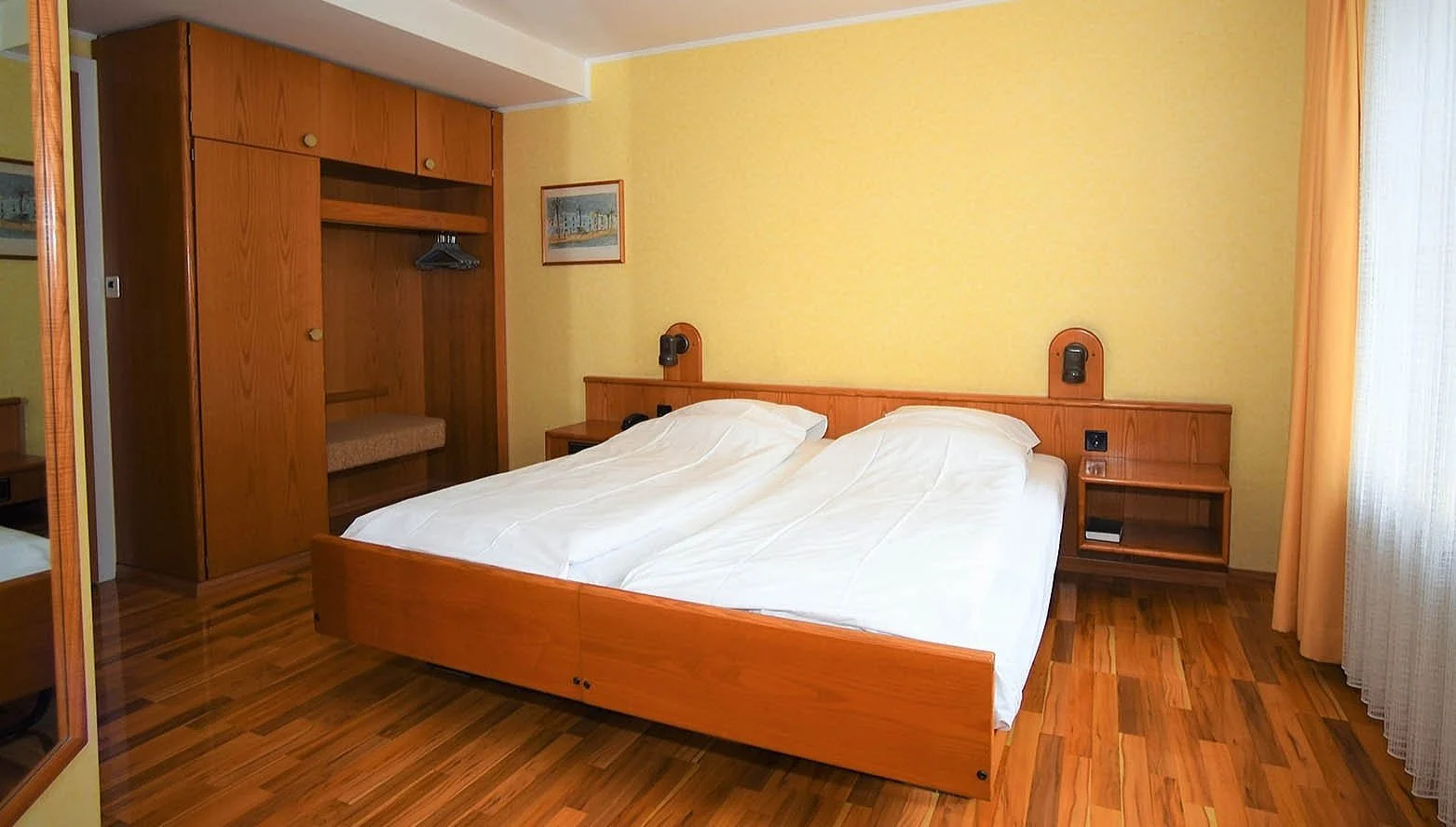
For a short 1-day stay in Zurich, it’s worth paying slightly higher rates for a central base near the historic center—one that allows you to walk to nearby points of interest while still commuting easily to the airport. Well connected to major public transportation routes along Limmatquai and conveniently located near iconic landmarks, Hotel Limmathof, situated in the heart of Zurich’s Old Town, offers 62 rooms distributed across two historic houses.
-
To continue on your journey through Switzerland, you won’t have to travel far—Zurich Hauptbahnhof (Zürich HB) is just a 5-minute walk across the river.
From there, Zurich Airport (ZRH) can be reached in 10–12 minutes via frequent direct S-Bahn and intercity trains stopping at Flughafen Zürich, with departures running every 5–10 minutes throughout the day.
The Central tram stop, located directly in front of Hotel Limmathof, provides excellent citywide connections and easy access to Zürich HB, making onward travel seamless.
All rooms come equipped with a private bathroom, 50+ channels on a flat-screen TV, a desk with a reading lamp, and all the other essentials you’d expect from an affordable, down-to-earth stay. This comfortable double room offered the perfect amount of space for two—even as we battled fevers in bed—and, if desired, these larger rooms are also available upon request for solo travelers.
No matter where you stay, ensure you can sleep soundly at night by securing travel medical insurance before you go.
I prefer SafetyWing Nomad Insurance for convenient coverage across borders, since I’m always looking to maximize an international flight with multiple passport stamps collected along the way.
The Essential plan is best suited for mid- to short-term travelers like me balancing a 9-5 with unexpected medical and travel risk coverage.
What to Do in Zurich?
Day 1
Breakfast - John Baker
Begin your Zurich one day itinerary at John Baker on Bahnhofstrasse, a local scratch kitchen summed up by its slogan, “for our daily bread.” Known for homemade baked goods crafted daily from sustainably sourced ingredients and fair production practices, the bakery is run by employees who view their work as a form of art. With complimentary sourdough starter offered to home bakers, John Baker is truly a community cornerstone.

Bahnhofstrasse
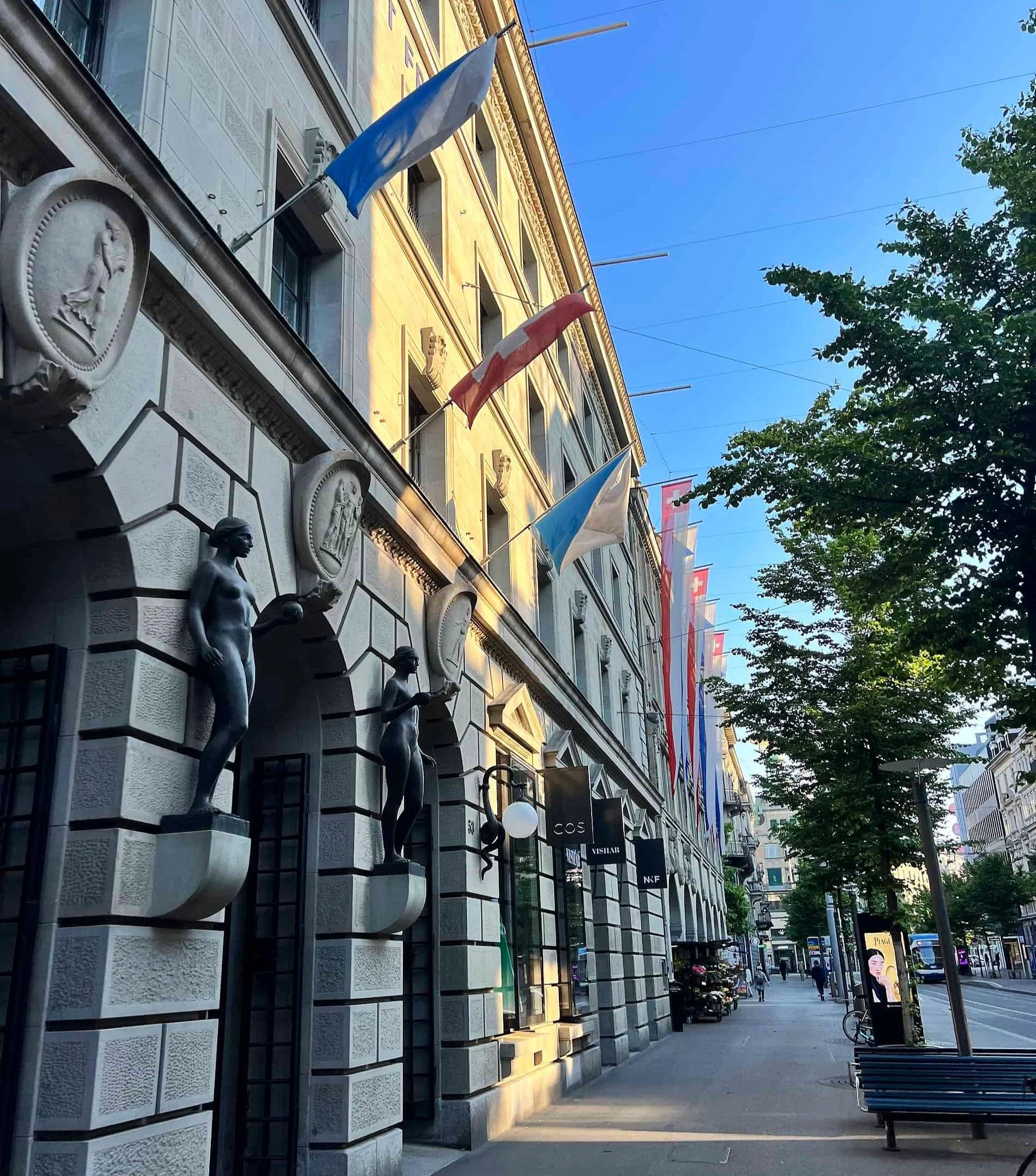
After breakfast, continue down one of the world's most luxurious shopping lanes: Bahnhofstrasse. Home to high-end boutiques, designer stores, and international flagship outlets, find a concentration of prestigious Swiss watchmakers—including Rolex, Patek Philippe, and Bucherer—alongside global names such as Chanel, Louis Vuitton, and Prada. Unless you came to Switzerland with the intent of acquiring one of these fabled timepieces, this stroll will likely be more of a window-shopping experience as opposed to intentional browsing.
Originally a humble street known as Fröschengraben, Bahnhofstrasse was transformed in the mid-19th century following the demolition of Zurich’s city fortifications. Today, the tree-lined promenade is lined with cultural landmarks like the Urania Observatory and Swiss National Museum—both of which can make educational additions to your list of Zurich places to visit in one day.
Lindt Home of Chocolate
FROM: Bahnhofstrasse (Bahnhofstrasse, 8001 Zürich, Switzerland)
TO: Lindt Home of Chocolate (Schokoladenplatz 1, 8802 Kilchberg, Switzerland)
TRANSPORTATION: Bürkliplatz → Kilchberg ZH, Lindt & Sprüngli via bus 165 (13 min, 11 stops, free w/ Swiss Travel Pass or CHF 11.60)
Conveniently connected to the rest of the city, you can depart from this central street toward Lake Zurich via trams or buses that are part of the city’s efficient public transportation system.

A trip to Zurich wouldn’t be complete without a stop at chocolate heaven, the Lindt Home of Chocolate. Through state-of-the-art, interactive exhibits, the museum brings the history, craftsmanship, and production of Lindt chocolate to life.
Step into the museum and you’ll smell it before you see it: the world’s largest chocolate fountain. Rising 30 feet high, this spectacular centerpiece is more than just a popular photo spot—the central stream features liquid chocolate cascading into an oversized truffle below. The constantly flowing cocoa waterfall fills the foyer with a rich, sugary aroma, tantalizing your taste buds before beginning a sensory exploration of all things chocolate.
The obvious—and undeniably best—part of visiting a chocolate museum is the tasting. I was stunned by the sheer volume of free samples offered to visitors, from unlimited spoons of dark, milk, and white liquid chocolate to chunks of exotic flavors infused with hints of orange, lime, and chili, plus generous helpings of Lindt truffles on the way out.
-
Wander through at your own pace with detailed commentary provided by a free audio guide, or sign up for a guided tour offering deeper insight into the cocoa journey from bean to bar
No matter how you choose to explore, the museum highlights the rich heritage of Lindt, a brand synonymous with Swiss chocolate excellence since 1845. Exhibits tracing the evolution of chocolate innovation sit alongside thoughtful displays on sustainability, ethical cocoa sourcing, and environmentally conscious production practices.
If you think you already know everything about chocolate, think again. As a frequent consumer of this sweet confection, I left with a newfound appreciation for the immense labor behind each variety—and for the generations of chocolatiers whose contributions have shaped the industry into a global orchestration.


For a more hands-on experience, participate in chocolate-making workshops led by expert chocolatiers, where you can create chocolate masterpieces to take home. Whether crafting fine bars, champagne truffles, or chocolate figures and lollipops, there’s sure to be a walk-in course suited to your sweet tooth.
Fraumünster
FROM: Lindt Home of Chocolate (Schokoladenplatz 1, 8802 Kilchberg, Switzerland)
TO: Fraumünster (Münsterhof 2, 8001 Zürich, Switzerland)
TRANSPORTATION: Kilchberg ZH, Lindt & Sprüngli → Bürkliplatz via bus 165 (13 min, 11 stops, free w/ Swiss Travel Pass or CHF 11.60)
After returning to central Zurich, walk five minutes along the river from the bus stop to reach Fraumünster. Included in the CHF 5 entrance fee is access to the underground crypt museum, which features a 1,200-year multimedia exhibition detailing the history of the city and the church, including the oldest surviving remains of Fraumünster Abbey. Open most days between 10:00 AM and 5:00 PM, last entry is permitted 15 minutes before closing.
-
Founded in 853 by Louis the German for his daughter, Fraumünster originally functioned as a convent for aristocratic women. As a result, the abbess wielded considerable influence during the Middle Ages, holding significant economic authority, including the right to mint coins and regulate local markets.
Today, the church is known for its blend of Romanesque and Gothic architecture, most notably its tall, slender copper spire that has weathered into a distinctive green patina. Five monumental stained glass windows by Marc Chagall, each depicting biblical themes in vivid color palettes, are among its most celebrated features.
Inside, visitors can also find a series of frescoes by Paul Bodmer, illustrating the founding legend of the abbey and the city’s patron saints, Felix and Regula.

Pro Tip:
To tour the interior of Grossmünster as well, a discounted combined ticket for CHF 8 is available, granting admission and audio guides to both historic sites.
Grossmünster
Walk three minutes across Münsterbrücke to reach Grossmünster, a slightly younger church with origins dating back to the early 12th century. According to legend, Grossmünster was founded by Charlemagne, who is said to have discovered the graves of Zurich’s patron saints at the site. With an entrance fee of CHF 5, the church is open daily from 10:00 AM to 5:00 PM, with reduced hours on Sundays from 1:00 PM to 6:00 PM.
-
Playing a crucial role in the Swiss Playing a crucial role in the Swiss Reformation, Huldrych Zwingli began preaching at Grossmünster in 1519, with his reforms leading to significant changes in church governance in Zurich and beyond.
The church is a prime example of Romanesque architecture, featuring twin towers accented with modern stained glass windows that now form a distinctive part of Zurich’s skyline.
Inside, visitors will find important historical elements, including the original seated figure of Charlemagne from the south tower, housed in the 12th-century crypt, as well as biblical texts that were examined as sources of truth during reformer debates challenging the authority of the established church.

Pro Tip:
A lesser known Zurich Switzerland travel tip, the base entry fee allows visitors to climb 187 steps up to Karlsturm—or Charles Tower—for panoramic views.
St. Peter’s Church
Journey six minutes down Münstergasse and across Rathausbrücke to reach the final church in this roundup of Zurich landmarks: St. Peter's Church. Originating during the medieval period, while the current building was consecrated in 1706, it stands on the site of earlier churches, with archaeological evidence suggesting foundations date back as early as the 9th century.
Rudolf Brun, Zurich’s first independent mayor, is buried at St. Peter’s Church, further underscoring its historical importance. Like the city’s other major churches, St. Peter’s played a central role in Zurich’s religious and civic life for centuries. Most notably, its tower features the largest church clock face in Europe, a defining landmark of the Old Town skyline.

Similar to Fraumünster, observe a blend of Romanesque and Baroque elements, including a simple yet elegant interior with a notable wooden pulpit and surrounding galleries that can be viewed free of charge. The church is generally open daily, with visiting hours typically running from 11:00 AM to 4:00 PM, and extended hours offered on weekdays.
Lindenhof
Stroll three minutes down Schlüsselgasse to Lindenhof, a peaceful green oasis and one of the best places to visit in Zurich Switzerland. Offering a tranquil escape from the bustling city streets below, its shaded paths, ancient trees, and inviting benches provide a setting for chess games, open-air events, and social gatherings.
-
Originally a Roman fort and later a significant medieval gathering place where citizens swore civic oaths, the park is a foundational site in Zurich’s transformation from Roman outpost to modern global city.
In the 9th century, Louis the German, grandson of Charlemagne, built a royal palace here, establishing the area as an early center of power and governance.
Today, remnants such as Roman tombstones and medieval artifacts remain on site, while the elevated park offers sweeping panoramic views across the Limmat River and over Zurich’s Old Town.

To fully enjoy this relaxing spot like a local, pick up snacks from the nearby Coop market and settle in for a casual picnic in the park. From the benches above, watch boats glide along the river and pedestrians stroll the opposite walkway as you enjoy a quick break with classic Swiss specialties.
Mühlsteg
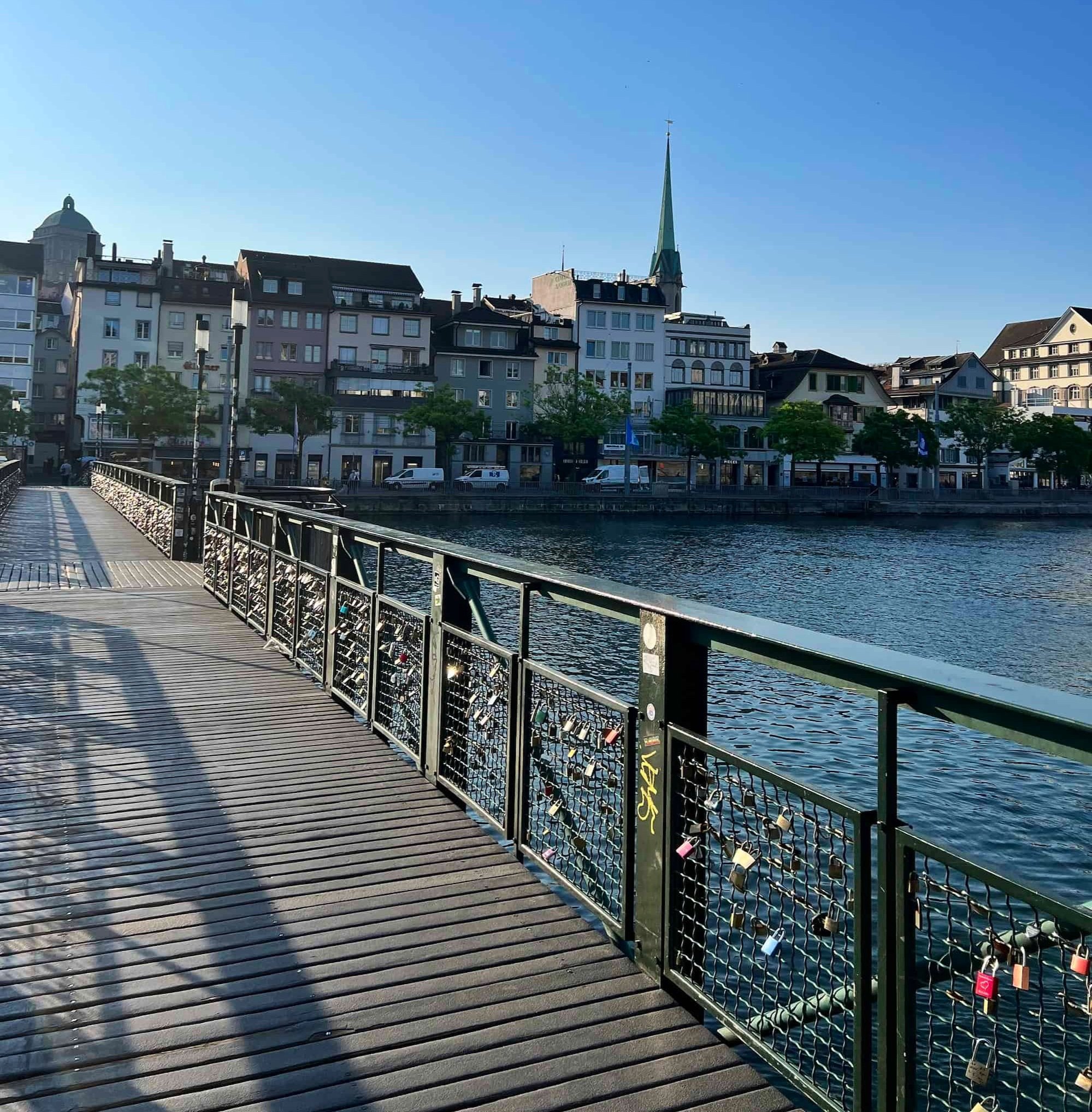
Continue with a 7-minute walk down Bahnhofquai to Mühlsteg, the pedestrian bridge famous for its love locks. A symbol of enduring romance, couples attach padlocks to the railing before tossing the keys into the river below. If you’re visiting Zurich with a partner and want to join in, opportunistic vendors often sell locks nearby, or you can stop into the local hardware store Garnier et Linker for a wider selection.
While attaching your lock, take in the picturesque views of the Limmat River and surrounding Old Town, including iconic landmarks you’ve already explored up close like Grossmünster and Fraumünster.
Dinner - Le Dézaley
Named after the famed Lavaux wine region, whitewashed Le Dézaley has been open since 1902, serving traditional, home-style Swiss cuisine such as fondue, rösti, and sausages for more than 120 years in a charming, garden-inspired setting.

Their world-famous fondue is made from mature Surchoix cheeses—offered in truffle and morel varieties—and is one reason guests from around the world visit this spot!
Best Day Trips from Zurich
With ultra-efficient access to Switzerland’s most scenic landscapes, Zurich makes the perfect urban base for venturing into the countryside and rounding out your trip with the breathtaking scenery the country is best known for:
Lucerne — just 45 minutes outside Zurich, this romantic Swiss city—best known for its covered Chapel Bridge—is one of the closest day trips, offering a view of preserved medieval architecture set against a glistening lake and dramatic alpine peaks. While Zurich has the modern underpinnings of a true city, compact Lucerne feels frozen in time, embodying quintessential Switzerland. Make the most of your visit with a guided tour that includes a ride on the revolving Rotair cable car up to Mount Titlis.
Interlaken — A 2 hour and 15 minute train ride brings you to Switzerland’s adventure capital, beloved by outdoor enthusiasts and adrenaline junkies alike. While I chose to spend a full 2 days in Interlaken, a day trip from Zurich can work if you’re short on time—though you likely won’t have enough time to take part in the destination’s most iconic experience: paragliding over the two lakes flanking town. Compare train ticket prices with coach transportation to find the most affordable transit option.
Lauterbrunnen — Hopping on another 20-minute train from Interlaken brings you to Lauterbrunnen, making the total transit time from Zurich roughly three hours. This dramatic U-shaped valley, where waterfalls cascade down sheer mountainsides, serves as the gateway to the Schilthorn cable car system, home to the rotating, James Bond–themed Piz Gloria restaurant at the summit. I stayed on the mountainside in Gimmelwald and spent 2 days in Lauterbrunnen in the area, but a day trip is still very doable if you remain close to town, exploring the waterfalls both above and below ground. For a guided day trip focused on falling water, consider a tour that includes a walk through the Aareschlucht Gorge— or book an itinerary that combines Interlaken and Lauterbrunnen into one action-packed day.
Jungfrau — Nicknamed the ‘Top of Europe,’ this bucket-list peak rises to 3,454 meters. The journey itself is an attraction, ascending over the Eiger Glacier by gondola before arriving at the Sphinx Observation Terrace, the Ice Palace tunnels, and Europe’s highest railway station. Notably, the transportation involved—including the authentic cogwheel train to Jungfraujoch—is one of the few routes not fully covered by the Swiss Travel Pass, making a guided tour a prudent option given the steep cost of transit tickets alone.
Liechtenstein — To collect another passport stamp while visiting Switzerland, consider a day trip to neighboring, German-speaking Liechtenstein—one of the least visited countries in Europe. Without an international airport, the tiny principality can only be reached via Switzerland or Austria, making it an easy and efficient addition to your itinerary while you’re already nearby. A highlight of this guided tour is Heidi’s Village, a Sound of Music–esque, picturesque hamlet filled with quaint chalets and a friendly herd of goats.
How Much Does One Day in Zurich Cost?
Following the above itinerary led the cost of a one-day trip to Zurich to be $218.73 for me as a recent graduate on a budget:
Lodging -$97.89
Transportation - $77.56
Food - $12.87
Activities - $14.46
Souvenirs - $15.95
If you’re already in Zurich, forgo the train ticket. I actually split my ‘Zurich in one day’ itinerary into two half-days—arriving in the afternoon after traveling back from Interlaken, then departing from Zurich Airport the next morning. If you’re on a tighter budget, skip the souvenirs; otherwise, this is a relatively inexpensive itinerary.
Assuming you don’t end up sick in bed halfway through the day, factor in the cost of lunch and dinner—unless you plan to survive off handfuls of Lindt truffles like I did. And if you have more time, budget for any additional attractions mentioned above.
What to Wear in Zurich?
Zurich’s sophisticated fashion scene is defined by quiet luxury and functional minimalism. Style here favors refined restraint over flash — less about seasonal trends, more about precision, quality, and versatility, where impeccable tailoring meets weather-ready practicality.
Think neutral palettes, clean lines, and elevated basics designed to move effortlessly from banking districts to lakeside promenades. Overdressing is rare, but sloppiness is noticed. Technical fabrics and polished layers reflect a contemporary lifestyle that balances corporate polish with outdoor ease, chosen to withstand shifting weather and long days on foot in a highly walkable city.
Sharp Blazers
well-tailored blazers with modern cuts are sleek investment layers suitable for the city's professional vibe


Cashmere Sweaters
high-quality cashmere offers warmth and understated style, comfort without compromising on refinement


Tailored Trousers
structured trousers lean into the local, ‘luxury without logos’ look during your walk around the city


Contemporary Sneakers
add modern flair to traditional businesswear with elevated kicks that contrast against your classic base


Leather Handbags
embrace the minimalist local look of clean lines by carrying a quality leather handbag with subtle, simplistic edge


Sophisticated Watches
if you have a special timepiece saved, wear it with intention in a city pushing the boundaries of modern horology


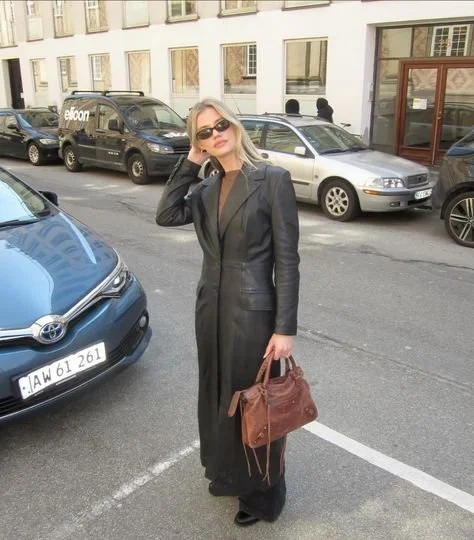
Discover where I purchased my pictured pieces with curated Zurich summer outfit inspiration to help you plan your own travel wardrobe!
Best Times to Visit Zurich
A true year-round destination with a distinct rhythm in every season, Zurich offers a balanced mix of Swiss culture, nature nestled in an urban home, and cosmopolitan city life as the calendar turns:
Spring (March–May) — As winter fades, Zurich begins to reawaken. Trees bloom along the Limmat River and Lake Zurich promenades, outdoor cafés slowly reopen, and locals return to parks and waterfront paths. March can still feel brisk, with temperatures hovering around 45 °F (7 °C), but by May daytime highs reach the upper 60s °F (18–20 °C). Spring is an excellent time to explore the Old Town without peak-season crowds, though light rain showers are common and layers are still essential.
Summer (June–August) — Summer is Zurich at its most vibrant. Long, double-digit daylight hours fuel lakeside swimming, open-air festivals like the August Street Parade, river floating along the Limmat, and evening drinks at outdoor terraces. Daytime highs typically range from 70–80 °F (21–27 °C), though heatwaves can occasionally push temperatures higher. While this is technically peak season, Zurich doesn’t become overwhelmed like smaller resort towns, plus the city’s proximity to the lake and nearby hills keeps it feeling fresh rather than congested.
Fall (September–November) — Autumn brings crisp air, golden foliage in city parks and nearby forests, and a noticeable slowdown after summer. September remains pleasantly mild, with highs in the mid-60s °F (18–20 °C), while November cools into the low 40s °F (5–7 °C). Fall is ideal for cultural travelers — museum visits, wine taverns, and scenic lake walks shine during this season — as it offers some of the most atmospheric views of the Old Town framed by colorful, changing leaves.
Winter (December–February) — Winter transforms Zurich into a festive, polished cityscape. Temperatures typically hover around freezing, with daytime highs in the mid-30s °F (1–3 °C). Snowfall is occasional rather than constant, but the holiday season is a major draw. Zurich hosts multiple Christmas markets, including the large indoor market at the main Zurich HB train station and smaller atmospheric markets scattered throughout the Old Town. Seasonal highlights include mulled wine, fondue cheese dinners, festive lighting displays, and easy train access to nearby ski regions for day trips like Flumserberg and Engelberg.
Is Switzerland Worth the Hype?
Switzerland may be one of the most expensive countries to visit in Europe, yet this is further evidence that the splurge is completely worth the hype. Why else would tourists keep coming back—and through every season—if visiting this costly country didn’t live up to their wildest hopes and dreams?
Switzerland’s jaw-dropping landscapes, impeccable infrastructure, and sustainable practices solidify its standing as a premier travel destination. The snowy peaks and pristine lakes of the Swiss Alps offer an unmatched backdrop, while modern sophistication delights within the charming cities scattered amongst the country’s natural scenery.
In my experience, Switzerland's commitment to quality is the secret sauce that elevates every facet of the country. This dedicated attentiveness is evident in the reliable transport system, exceptional cleanliness, widespread safety, and delectable culinary delights pervasive throughout the land. Ensuring an indulgent and comfortable travel experience for all, Swiss conscientiousness extends to their hospitality, from which you can always expect a warm welcome and sense of ease.
The 5 days I spent zooming through Lauterbrunnen, Interlaken, and Zurich were not nearly enough, and I’ll surely be booking a flight back as soon as the moment is right. I’ve raved about the merits of Switzerland to all my friends and family and the same message is true for you: visit Switzerland and it will be an adventure you’ll cherish forever!
Zurich for First-Timers: FAQs
What language do they speak in Zurich?
Switzerland has four national languages — German, French, Italian, and Romansh — with German being the primary language spoken in Zurich. Locally, residents speak Swiss German (Schweizerdeutsch) in everyday conversation, however as Switzerland’s largest and most international city, Zurich is exceptionally English-friendly. Hotels, restaurants, shops, museums, and transit staff generally speak fluent English, and navigating the city poses little challenge for English-speaking travelers.
What is the currency in Zurich?
Payment in Zurich is made using Swiss francs, the country’s official currency, abbreviated as CHF or Fr. While some businesses in heavily trafficked areas may accept euros, the exchange rate is typically unfavorable and change is almost always returned in francs, making it best to carry CHF.
Visa, Mastercard, and usually American Express credit card payments are widely accepted throughout Zurich with cash becoming increasingly optional, though still useful for small kiosks, older establishments, or occasional cash-only vendors. Tipping is not required, as service charges are included in menu prices; however, rounding up the bill or leaving a small addition for exceptional service is customary and appreciated.
What is Zurich known for?
Zurich is Switzerland’s largest city, best known for its medieval Old Town, global financial influence, and exceptional livability. The city features landmarks like St. Peter’s Church, which boasts the largest clock face in Europe. Add in world-class shopping along Bahnhofstrasse and iconic Swiss experiences like chocolate culture at the Lindt Home of Chocolate, and Zurich stands out as both cosmopolitan and distinctly Swiss.
How many days in Zurich?
Zurich can be easily explored in one day, thanks to the compact layout of its Old Town, where many of the city’s key landmarks are clustered within walking distance. Additional days are best spent using Zurich as an urban base for day trips to nearby destinations like Lucerne or Interlaken, with seamless access to alpine landscapes via Switzerland’s famously punctual public transit system.
Is Zurich worth visiting?
Zurich isn’t necessarily a bucket list destination to go out of your way to visit, but it’s absolutely worth exploring if you’re already nearby, especially as a first stop in Switzerland. With a major international airport and seamless rail connections, Zurich often makes the most sense as an entry point into the country.
What to see in Zurich in 1 day?
Zurich can be seen in one day by focusing on its Old Town, shopping promenades, and lakeside scenery. Highlights include strolling Bahnhofstrasse, visiting the Lindt Home of Chocolate, and exploring Zurich’s historic churches—Fraumünster, Grossmünster, and St. Peter’s Church. Round out the day with city views from Lindenhof, a stop at Mühlsteg, and a traditional Swiss fondue dinner.
✺ TRAVEL TOOLS ✺
Add this Zurich map to your phone for easy navigation during your trip (Google Maps)
Keep a short list of my Zurich recommendations handy (Benable)
Save money with the Swiss Travel Pass (GetYourGuide)
✺ ABOUT ME ✺

Hi, I’m Ashley. I’m determined to see the world. All of it. Are you coming with?
While I respect the digital nomads, van life, and the hardcore backpackers—that’s just not me.
I’m convinced I can travel and keep my job.
It’ll take a lifetime, but I’m going to make it to all 195 countries before my time is up—and I’m taking you along for the ride!
✺ READ MORE ON THE BLOG ✺





![How to Drive Moonview Highway IRL: Mario Kart Japan [2025]](https://images.squarespace-cdn.com/content/v1/652732149424c20baf5e26c9/1738472940390-H4PXMWODU3MAQVIIOJ8I/IMG_1412+copy+%281%29.jpg)


![Tokyo’s Top Sites – How to Buy Shibuya Sky Tickets [2025]](https://images.squarespace-cdn.com/content/v1/652732149424c20baf5e26c9/1736655941250-HONDE4J7JOOEN5NJNNLJ/IMG_8461+copy+%281%29.JPG)